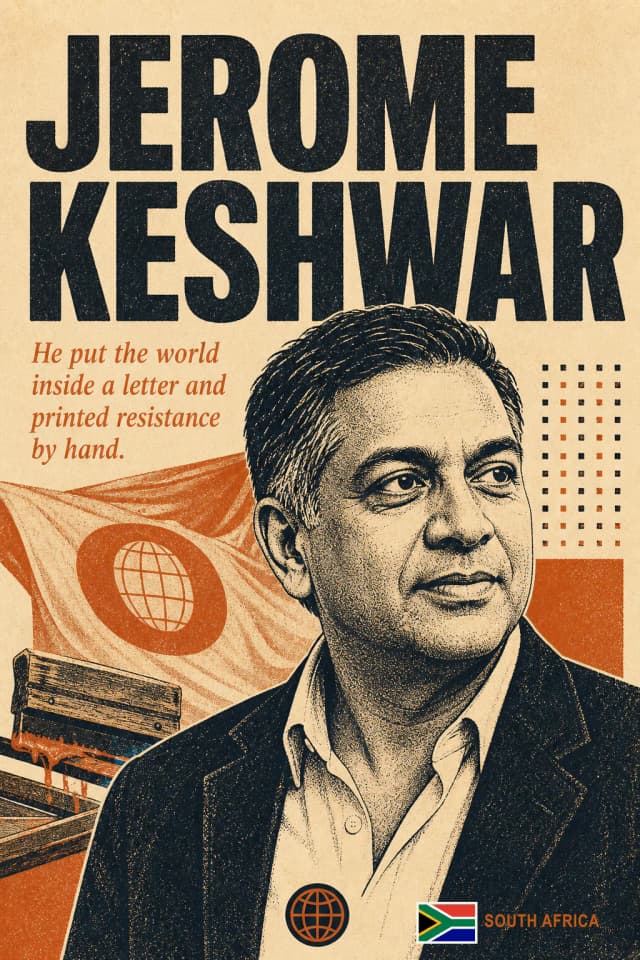
The Man Who Put the World Inside a Letter
Jerome Keshwar
Self madeStory One is told by Jerome Jeshwar in his own account. It is not assembled from reporting.
He taught himself to print by hand and worked at night, pulling a squeegee across a screen in a country where the message on the shirt was dangerous to carry. He printed one that read The World Against Apartheid and turned the O of WORLD into a globe. Forty years later he is doing the same job with a different machine.
Hy het homself geleer om met die hand te druk en het snags gewerk, 'n rakel oor 'n sif getrek in 'n land waar die boodskap op die hemp gevaarlik was om te dra. Hy het een gedruk wat gelees het The World Against Apartheid en die O van WORLD in 'n aardbol verander. Veertig jaar later doen hy dieselfde werk met 'n ander masjien.
A country with the channels shut
Jerome Keshwar is a South African. He came into working life in a country that was arranged so that most of the people in it could not be heard, and he came into it with no behind him. There was no family business to walk into, no equipment to inherit and no bank that was going to lend against an idea. He does not present that as hardship. He presents it as the starting condition, the thing you work from.
To understand what he did next you have to understand what a printed message was worth in South Africa in those years. Television was state controlled. Newspapers were censored, and the ones that pushed back were harassed, banned or closed. Radio was licensed. The face of Nelson Mandela was not something a person saw in general circulation, because circulating it carried real consequences for the person who did it. A young man with something to say and no money had no route into any of those channels. It was not that they were expensive. They were shut.
What was not shut was cloth. A shirt is a surface. It moves on its own legs, it goes where the person wearing it goes, and nobody licenses it. Screen printing needed a frame, a mesh, a stencil, ink and a squeegee, and after that it needed hands and hours. That was the entire requirement. It was the cheapest technology available in the country and it was the only one he could reach.
So he learned it. Not at a school, and not in any apprenticeship he talks about. He learned it the way people learn a trade when there is no other way in, which is by doing it badly and then doing it less badly. He does not say what the first jobs were or who paid for them. He says what the work was. A screen, a squeegee, ink, and a shirt flat on the table in front of him, at night, after the day was finished.
That is the beginning of it. A man with his hands, a trade he taught himself, and a country in which the thing he most wanted to put in front of people was the one thing that could not be said out loud.
'n Land met die kanale toe
Jerome Keshwar is 'n Suid-Afrikaner. Hy het die werkende lewe binnegegaan in 'n land wat so ingerig was dat die meeste mense daarin nie gehoor kon word nie, en hy het dit binnegegaan sonder enige kapitaal agter hom. Daar was geen familiebesigheid om in te stap nie, geen toerusting om te erf nie en geen bank wat teen 'n idee sou leen nie. Hy stel dit nie voor as swaarkry nie. Hy stel dit voor as die beginvoorwaarde, die ding waarvandaan jy werk.
Om te verstaan wat hy daarna gedoen het, moet jy verstaan wat 'n gedrukte boodskap in daardie jare in Suid-Afrika werd was. Televisie was staatsbeheer. Koerante is gesensor, en dié wat teruggestoot het, is geteister, verban of gesluit. Radio was gelisensieer. Die gesig van Nelson Mandela was nie iets wat 'n mens algemeen in omloop gesien het nie, want om dit te versprei het werklike gevolge gedra vir die persoon wat dit gedoen het. 'n Jong man met iets om te sê en geen geld nie het geen pad in enige van daardie kanale gehad nie. Dit was nie dat hulle duur was nie. Hulle was toe.
Wat nie toe was nie, was materiaal. 'n Hemp is 'n oppervlak. Dit beweeg op sy eie bene, dit gaan waar die draer gaan, en niemand lisensieer dit nie. Sifdruk het 'n raam, 'n gaas, 'n sjabloon, ink en 'n rakel nodig gehad, en daarna het dit hande en ure nodig gehad. Dit was die hele kapitaalvereiste. Dit was die goedkoopste verspreidingstegnologie in die land en dit was die enigste een waarby hy kon uitkom.
So het hy dit geleer. Nie by 'n skool nie, en nie in enige vakleerlingskap waarvan hy praat nie. Hy het dit geleer soos mense 'n ambag leer wanneer daar geen ander pad in is nie, naamlik deur dit sleg te doen en dan minder sleg te doen. Hy sê nie wat die eerste werke was of wie daarvoor betaal het nie. Hy sê wat die werk was. 'n Sif, 'n rakel, ink, en 'n hemp plat op die tafel voor hom, in die nag, nadat die dag klaar was.
Dit is die begin daarvan. 'n Man met sy hande, 'n ambag wat hy homself geleer het, en 'n land waarin die ding wat hy die graagste voor mense wou plaas, juis die een ding was wat nie hardop gesê kon word nie.
This chapter draws on 2 sources
Supporting references are listed for context. The story itself is told by its subject.
- Recorded conversation with the subject2026-07-28
- Recorded conversation with the subject2026-07-28
Listen to this chapter.
The audio automatically follows the chapter selected below.